Epilogue I
Contours of the Psyche: Where Neuroscience Meets Human Complexity.
In the end, it is perhaps fitting that our expedition through the variegated landscape of the human mind concludes not with triumphant certainties, but with contemplative ambiguity. For what greater testament to our neuropsychological richness could there be, than to end in a space where answers are not finite, but fluid; where disorder whispers its own logic, and complexity becomes its own reward?
This Epilogue does not propose to fix what is commonly termed pathological, but rather to place it under a new light, a lens both scientific and humanistic. Personality disorders, far from being mere diagnostic categories, may be better understood as the natural overgrowth of otherwise beneficial traits, adaptive vines which, given too much shade or sun, entwine a little too tightly. What is obsessiveness, if not a misdirected pursuit of precision? What is dependency, but trust taken to its most anxious form? The so-called pathological begins to seem not like a deviation, but an excess.
And so, we pivot. From the measurable clarity of neuroscience and the robust anatomy of neurobiology, through the dynamic plasticity of neurocognition, we turn now into the shimmering fog of neuropsychology. Here, unlike its more empirical siblings, we do not hold the brain in a test tube, but observe the mind behind the curtain, shaped by memory, emotion, history, and identity. This is where science touches art, and where data yields to story.
Indeed, to understand the psyche, the uniquely human terrain of thoughts, dreams, contradictions, and yearnings, we must acknowledge its dual allegiance. It owes itself partly to the natural world, governed by neurotransmitters and hormonal surges, and partly to the narrative world, composed of archetypes, aspirations, and afflictions. It is precisely this hybridity that positions neuropsychology not merely as a science, but as a bridge to the humanities.
Let us recall our musings on cognitive dissonance, not as failure, but as fertile ground for mental growth. Might not the same logic be extended to the psychological conditions we fear, mislabel, or misunderstand? Perhaps our neurodivergences, our so-called pathologies, are less blemishes on the human canvas and more like brush strokes of a complex masterpiece still in progress.
This closing script thus acts not as a period, but as an ellipsis. It marks the conclusion of our foundational collection, yet gestures forward, to new questions, new hypotheses, and new fusions between synaptic science and subjective experience. The Enkephalos project, like the mind itself, is far from complete. It is a living organism, growing in dialogue with its readers, ever inviting the curious to peer deeper.
To that end, may this Epilogue serve not as the final word, but as an intellectual torch passed into your hands. May you wield it to illuminate the dark, to interrogate the complex, and, above all, to celebrate the marvellous messiness that is the human mind.
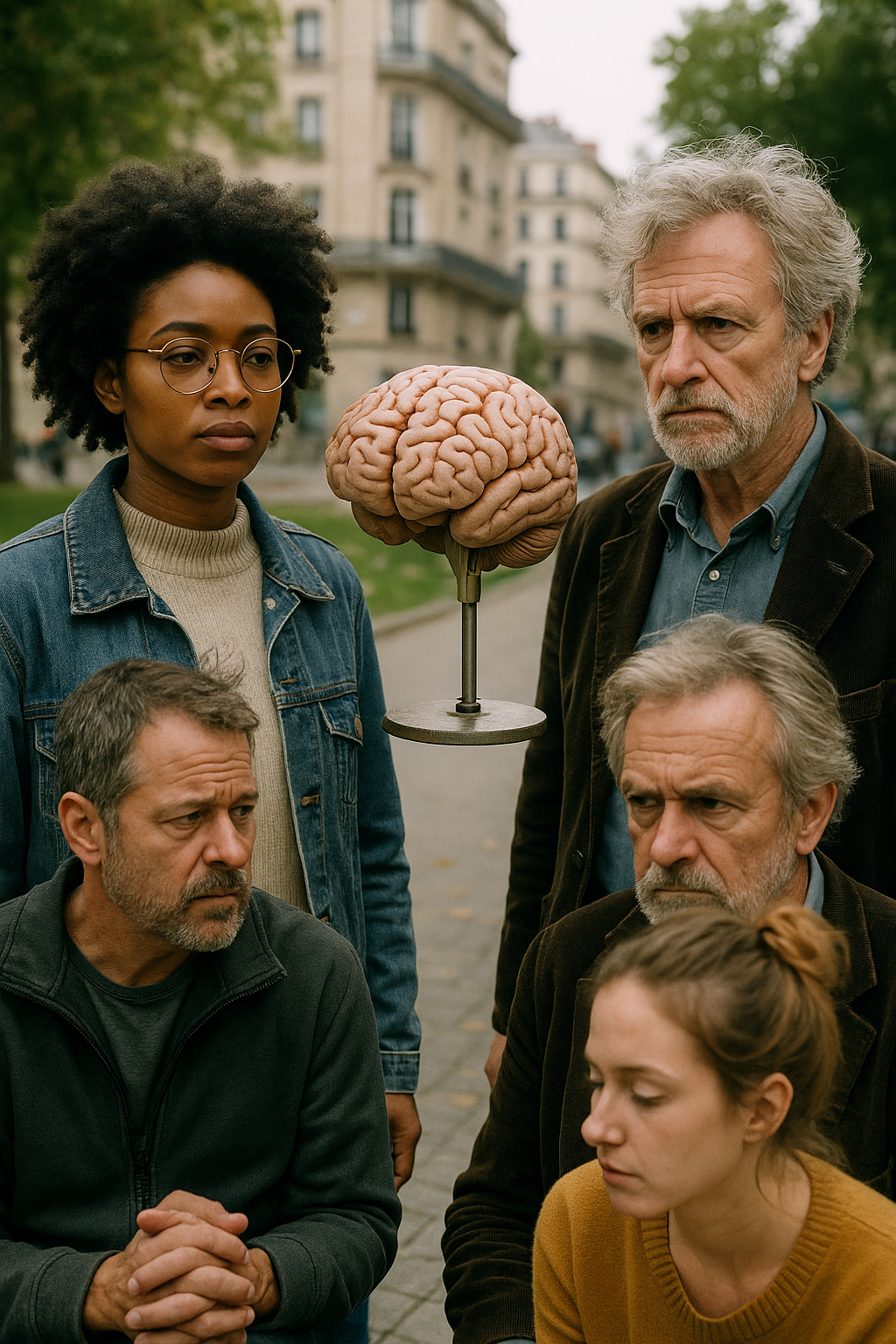
Listen up.
As we close this first Enkephalos script collection, let us pause to consider: are our so-called disorders not merely diverse reflections of the human psyche? From neurobiology to neuropsychology, we have traversed the scientific and the deeply personal, only to arrive at a simple truth: complexity is not a flaw, but a feature of being human.
-
Core Academic Texts
“Principles of Neural Science” by Eric R. Kandel et al.
A foundational neuroscience textbook exploring the mechanisms of the brain, ideal for bridging neurobiology with cognition and behaviour.“The Man Who Mistook His Wife for a Hat” by Oliver Sacks
A clinical yet poetic exploration of neurological disorders that illuminates the spectrum of neuropsychological individuality.“An Anthropologist on Mars” by Oliver Sacks
Personal narratives showing how individuals adapt and thrive with neurological differences.“The Developing Genome: An Introduction to Behavioral Epigenetics” by David S. Moore
Insight into how genes and environment influence behaviour and mental diversity.
Philosophical & Humanistic Perspectives
“The Divided Self” by R.D. Laing
A pioneering study in existential psychology that challenges rigid psychiatric labels.“The Ego and the Id” by Sigmund Freud
An essential psychoanalytic text tracing the architecture of personality.“The Interpretation of Dreams” by Sigmund Freud
A humanistic and narrative-driven look at the role of the subconscious in mental life.
Modern Neuropsychology & Diversity
“Neurotribes: The Legacy of Autism and the Future of Neurodiversity” by Steve Silberman
Explores the history and cultural context of neurodiversity with a progressive scientific lens.“The Master and His Emissary” by Iain McGilchrist
A sweeping theory on the divided brain and its impact on culture, identity, and thought.“Psychiatric and Mental Health Nursing: The Craft of Caring” by Mary Chambers
Addresses practical and ethical approaches to managing psychological diversity.
Media & Accessible Resources
BrainFacts.org
An open-access educational platform supported by the Society for Neuroscience.APA PsycNET (American Psychological Association)
Access to peer-reviewed psychological research.The Neuropsych Podcast
Weekly episodes discussing neuropsychological themes with leading researchers.Stanford Human Behaviour and Mental Health Lectures (YouTube)
Public lecture series blending psychology, psychiatry, and neuroscience.